
ものを巡る物語。
The stories behind the development of the product
journey
#01
美術家、福田匠さんを尋ねて。
Inquire about the artist Takumi Fukuda.
丹ゆう art gallery
福田 匠 さん

丹ゆうとは
about TANYU
丹波篠山で「丹ゆう TANYU art gallery」を主宰されている美術家・福田匠さんと初めてお出会いをいただいたのは、2022年葉月の末の日でした。
Instagramで「丹ゆう」が生まれるまでの解体・基礎工事・束石と古材による柱建て・瓦葺き・造園などの作業風景を、美しいモノクロ写真でライブ発信されているのを、どんな人がこのような美しいものを建てているのだろうとワクワクしながら眺めていたことを思い出します。
そしてある日、モノクロ写真は色彩を纏って投稿されました。
「丹ゆう」の誕生です。
福田さんは、屋号の「丹ゆう」についてこのように書かれています。
“丹”は丹波篠山の丹であり、“ゆう”は漢字で表すと熊である。
紀伊半島の熊野地方が私の故郷であるということ、また敬愛する南方熊楠の名から拝借したのが理由である。
私は熊野の信仰や歴史に深い興味を抱いており、関連する文献を紐解いてはフィールドワークのような真似事をして、密かに民俗学者を気取っている。
(※Instagramより引用)
開廊日ではなかったにも関わらず快く予約を受けてくださった福田さんからは、「自身のこだわりによりエアコンなどの家電類を設置しておりません。この時期、お客さまにはご迷惑・ご不便をお掛けいたしますがご了承くださいませ。」と丁寧なご案内をいただいていました。
ナビを頼りにしばらく歩くと、大きな桜のシンボルツリーの下、樹下聖堂のような小屋が現れました。
出て来られたのはまさに熊楠のような風貌の、哲学者の如き佇まいの方でした。
It was on a late leaf day in 2022 when we first met Mr. Takumi Fukuda, an artist who runs “TANYU art gallery” in Tamba Sasayama.
I remember watching him live on Instagram with beautiful black-and-white photos of the process of demolition, foundation work, pillar construction using bundle stones and old lumber, tiled roofing, landscaping, etc. up to the birth of “TANYU,” and wondering with excitement what kind of person would build such a beautiful thing.
Then one day, the black-and-white photos were posted in color.
This was the birth of “TANYU.”
Mr. Fukuda wrote about the trade name “Tanyu” as follows.
"Tan” is the ‘tan’ of Tanba Sasayama, and ‘Yu’ is the ‘bear’ in Chinese characters.
The reason for this is that the Kumano region of the Kii Peninsula is my hometown, and I borrowed the name from my beloved Kumagusu Minakata.
I have a deep interest in Kumano's beliefs and history, and I secretly pretend to be a folklorist by doing fieldwork to unravel related literature.
(*Taken from Instagram.)
Mr. Fukuda, who graciously accepted our reservation even though it was not the opening day of the gallery, told us, “Due to my own particular preference, I have not installed any air conditioners or other appliances. We apologize for any inconvenience this time of year may cause you. He politely informed us that he was sorry for any inconvenience to our guests during this season.
After walking for a while with the help of the navigation system, a hut like a cathedral under a tree appeared under a large symbolic cherry tree.
The person who came out of the hut looked like a philosopher with a Kumagusu-like appearance.

お伺いした日は、ちょうど移転前のsalon & gallery 虹霓(月虹舎文庫直営店)が稼働したばかりで、古代染織技法を尋ねて神話の里を逍遥していた私は、福田さんの「岩戸開」と銘打たれた作品に惹かれました。
高千穂で拝見した天岩戸神社の荘厳な洞ではなく、まるで今まさに開かんとする長く閉じられていた魂の核を内観したような、精神性の高い作品でした。
他にも、途方もない時間をかけて制作された地層のような作品や、神代杉を潔く枌(へぎ)加工した作品など、福田さんの視点で集められた美しい品々をじっくりと拝見させて頂きました。
On the day I visited Mr. Fukuda, the salon & gallery Kougei (directly managed by Gekkosha Bunko) had just started operation, and as I was floundering around the mythical village in search of ancient dyeing and weaving techniques, I was attracted by his work titled “Iwato-Biraki” (Opening of Iwato).
It was not the solemn cave of Ama-no-Iwato Shrine that I saw in Takachiho, but a highly spiritual work, as if it were an inside view of a long-closed spiritual core that was just about to open.
We also had the opportunity to take a good look at other beautiful items collected from Mr. Fukuda's point of view, such as an artist's work that looks like a geological formation created over a tremendous amount of time, and a work made of hegi-worked Jindai cedar.


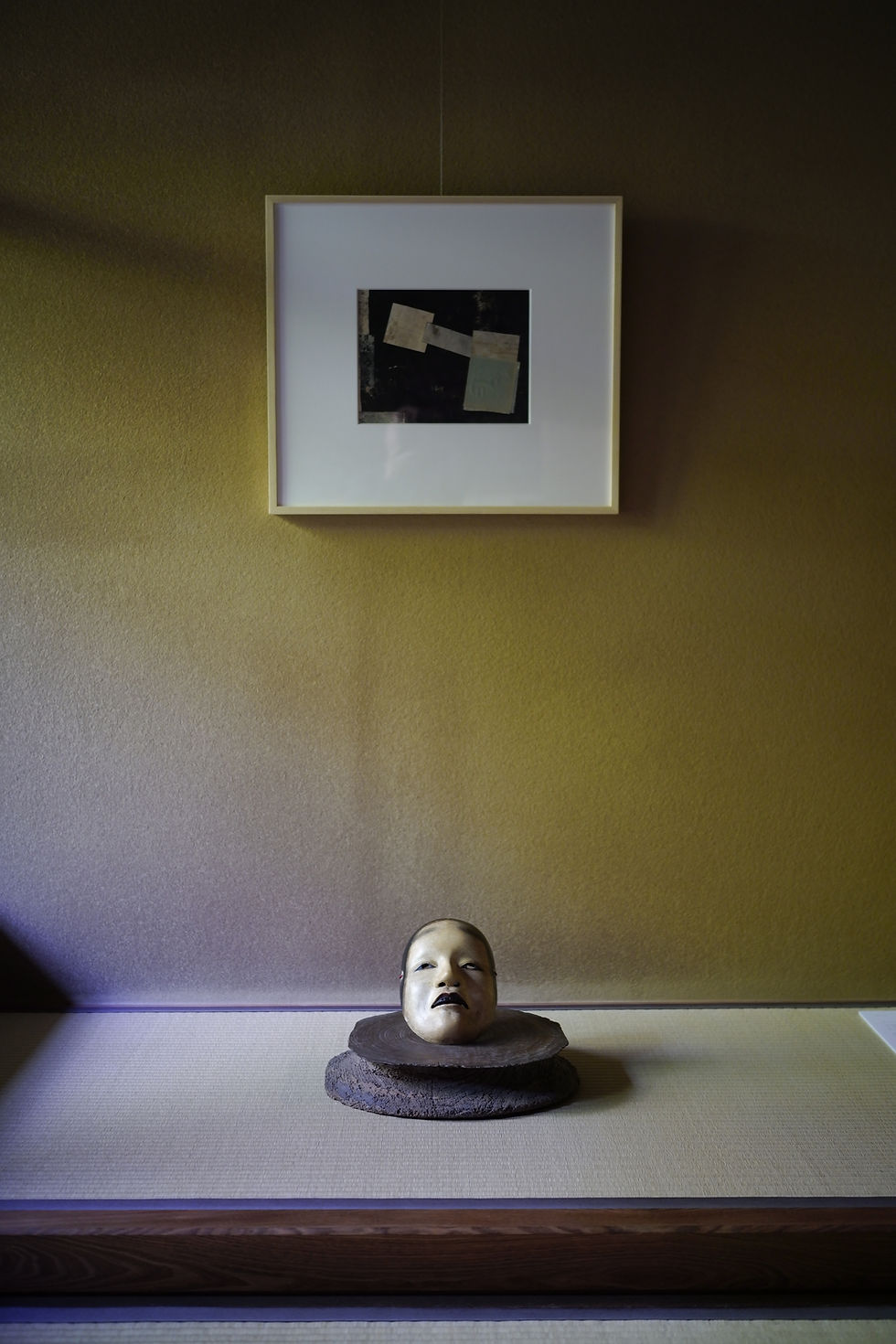
お互いに神話や古代史を作品のイマジネーションの源泉とすることから意気投合し、移転後のsalon & gallery 虹霓では、四季ごとに床の間の室礼を福田さんにお願いすることになりました。
床の間は、日本家屋で最も神聖な場所と云われます。
それは、「神の遊び場」であるからです。
福田さんの作品は平面でありながら、カメラの長時間露光のように筆の軌跡が空間に残され、思索の耽溺時間がキャンバスに表れています。主に油彩で表現されますが、ピカソやマティスが愛したというフランス製のアルシュの耳付き紙に描かれるため、どことなく和の印象も伴います。
福田さんが蒐集された骨董と共にしつらえられた作品は、ひとつの物語として、見る人を時空の旅へと誘ってくれます。
We hit it off because we both have mythology and ancient history as the source of imagination for our works, and after the relocation, we decided to ask Mr. Fukuda to create an alcove for each of the four seasons at salon & gallery Kougei.
The tokonoma is said to be the most sacred place in a Japanese house.
This is because it is the “playground of the gods.
Although his works are two-dimensional, the traces of his brush strokes are left in the space, like the long exposures of a camera, and the canvas shows the time he spends in contemplation.
Although mainly expressed in oil, his works are painted on French-made Arches paper with ears, which is said to have been loved by Picasso and Matisse, and thus have a somewhat Japanese feel to them.
The works of art, displayed with antiques collected by Mr. Fukuda, take the viewer on a journey through time and space as a single story.


salon & gallery 虹霓にて開催された朔月会・「丹ゆう展」では、福田さんの作品のみならず、取り扱い作家さんの美しい品々を、福田さんご自身で空間にしつらえていただきました。
どの品にも、アーティストへの理解と尊敬に満ちた文章を添えてくださり、福田さんが見つめている時空を私たちも共に楽しませていただくひと時となりました。
At the “TanYu Exhibition” held at salon & gallery Kougei
Mr. Fukuda himself decorated the space with not only his own works but also beautiful items from the artists he handles.
Each piece was accompanied by a text filled with understanding and respect for the artist, and we were able to enjoy the time and space that Mr. Fukuda gazes upon.
アートをしつらえる。
Arranging art.

福田さんはご自身がアーティストでありながら、ギャラリストとしての側面もお持ちで、「丹ゆう」取り扱いアーティスト作品も構成に含む優れた空間構成力を発揮されます。
アーティストへのリスペクト、作品への理解が生む美しい室礼では、随所に取り合わせの妙を見ることができます。
Mr. Fukuda is an artist himself, but he is also a gallerist, and he demonstrates excellent spatial composition skills, including works by other artists.
The beautiful room decorations, which are the result of his respect for artists and understanding of their work, show the beauty of the combination of the two in many places.

2025年4月、京都府京丹波町にある名ギャラリー・gallery白田にて、福田さんの個展が開催されています。
福田さんのルーツでもある熊野を主題に、神話の神々の痕跡や、古代人の信仰が息づく場所を取材し、実験的かつ即興的な旋律で奏でられた作品の数々。
「生と死は対立し合うものではなく、生の中には死が、死の中には生が孕んでいるという一定の場所に留まらない流動的エネルギーのダイナミズムを予感させる」と個展の主旨を語られている通り、福田さんの審美眼で採取された時空を超えるオブジェクトと、内から生まれ出た息吹ともいえる色とりどりの小品集から成る空間は、護摩焚きのような激しさよりも、寧ろ声明(しょうみょう)のような静けさを湛えています。
会場は2手に分かれています。
オーナー・石井直人氏による陶板敷の床に、田に打たれた栗の杭を床柱とした新設ギャラリーには、土から変性して生まれいずる陶器の如く、「火」を彷彿とさせるモチーフが。
対して、オーナー・石井すみ子さんの設計による白いギャラリー空間は、伊邪那美の死体からさえ生まれ来る神々の如く、子宮の中で見る夢のように淡い色彩で描かれた作品が並びます。
同じタイトルで、制作年代のみを附番していく福田さんの名付けスタイルの中で、珍しく「Still life」と銘打たれた作品がありました。
個展のDMにも採用された作品は、福田さんの中にある潜在的、感覚的なものが表出したものだそうです。
タイトルの由来は、水彩画のような繊細な色の重なりが静物画にも見えるから、とのことでしたが、私には古代の死と再生の儀式「魂振り」の魂ゆらのように見えました。
福田さんの作品は、これまでコラージュ、立体、具象絵画、そして抽象と、知的興味の赴くまま大きくスタイルを変えてきました。「常に変化したい」と仰る通り、個展の制作過程で花開いてきた一つが色彩だそうです。
かのルドンが黒から色彩に目覚めたように、今まで色を制限し制作していたモノトーンやアースカラーのキャンバスから、まさに花がほころぶように描かれた色は、作品を眺める人を威圧することも排除することもなく、時を経た骨董のように、ただ「共に在る」と見る人を受け入れるものでした。
福田さんは理想の制作というものを、「漬物を漬けるように、洗濯物を干すように、スイッチで入れ替わるものでなく生活と地続きであるのが目標」と仰っています。
「考える人」である福田さんが、「頭で考えたコンセプチュアルなこと抜きに素が出た」という作品は、奇を衒うこともなく、人におもねることもなく、内的世界が優しく滲み出ているものでした。
アーティストにとって素で勝負するというのは、人前で丸裸になるような、かなり勇気が要ることではないかと推察します。それをさらりと成し遂げてしまった今回の個展での福田さんの変容を、私は丹波に移住しご家族と過ごす時間の中で成形された、人間力の熟成と感じました。
福田さんが制作に当てる時間だという夜の静謐の中では、次第に視界がぼやけ、変性意識に入っていくような時間が訪れます。
一説には、人間の顕在意識は潜在意識に対してたった3%と云われます。
潜在意識は常世と繋がっています。
私たちは何かを生み出す時、伊邪那美の死と再生の地にアクセスしているのかも知れません。
In April 2025, Mr. Fukuda's solo exhibition is being held at gallery Hakuden, a renowned gallery in Tanba Sasayama.
Taking Kumano, the place of Mr. Fukuda's roots, as the subject, his works are experimental and improvisational in melody, covering traces of mythological gods and places where the beliefs of ancient people still live.
As she says of the purpose of her solo exhibition, “Life and death are not in conflict with each other, but rather, I foresee the dynamism of fluid energy that does not stay in a certain place, where death is contained within life and life is contained within death. The space is filled with objects that transcend time and space, and colorful small works that seem to come from within, and is more like a silent statement than the intensity of a goma-burning ceremony.
The venue is divided into two parts.
The new gallery, with a ceramic floor by owner Naoto Ishii and chestnut stakes driven into the rice paddies as floor posts, has a motif reminiscent of “fire,” as in the case of ceramics that are born from the denaturation of clay.
In contrast, the white gallery space designed by Sumiko Ishii, the owner of the gallery, is lined with works painted in pale colors, as if they were dreams seen in a womb, like gods born even from the corpse of Iyanami.
One work was unusually titled “Still life” in Fukuda's naming style, in which the same title is given only the date of creation.
This work, which was also used for the DM of his solo exhibition, is said to be the manifestation of something latent and sensual within Mr. Fukuda.
The origin of the title was that the delicate layering of colors, like a watercolor painting, looks like a biological painting, but to me it looked like a tama-yura, a tama-yura from the ancient ritual of death and rebirth called “tama-furi.
Fukuda's work has varied greatly in style from collage to sculpture, from figurative painting to abstraction, as his intellectual interests dictate. As he says, “I always want to change,” one of the areas that has blossomed in the process of creating his solo exhibitions is color.
Just as Redon's black awakened his interest in color, the colors painted on the canvas, which had been created by restricting colors to monotones and earth tones, were like flowers unfurling, neither overpowering nor excluding the viewer, but simply embracing the viewer like a timeworn antique, “existing together. They are like time-honored antiques that simply “belong together” with the viewer.
Mr. Fukuda says that his ideal production is not something that can be switched on and off, like pickling pickles or hanging laundry out to dry, but something that is connected to daily life.
As a “thinker,” Mr. Fukuda's works, which he says “come from the heart without being conceptual,” do not try to be eccentric or take advantage of others, but rather gently exude his inner world.
For an artist to compete with his or her true self is something that requires a great deal of courage, like being completely naked in front of others, I guess. I felt that Fukuda's transformation in this solo exhibition, which he accomplished without hesitation, was the result of the maturation of his human ability, which was formed during the time he spent with his family after moving to Tamba.
In the tranquility of the evening, which Mr. Fukuda says is the time he devotes to his work, his vision gradually blurs and he enters a state of altered consciousness.
According to one theory, the manifest consciousness is only 3% of the subconscious.
The subconscious is connected to the everlasting world.
When we create something, we may be accessing the land of death and rebirth of Izanami.


Instagramで、福田さんはこのように書かれています。
「紀伊山地の霊場と参詣道」として、熊野とともに世界遺産に登録されている高野山の開創伝説には丹生都比売(にうつひめ)が深く関わっている。
なにやら熊野周辺には“丹”がついてまわるらしい。
やはりこの二文字をきっかけに屋号を決めたのは間違いではなかった、“丹”と“熊”は私にとって結びつく運命だったのだ、と一人で深く頷いたことを思い出す。
今、こうして丹波篠山の地に「丹ゆう」が誕生し、この3年で若く志あるアーティストが集う地として、ますますの発展を見せる同地。
福田さんが出身地である熊野の守護神・丹生都比売が護る場所から導かれ、丹波に居を成したのも、決して偶然ではないでしょう。
何故なら丹波は最古の家系図を持つ海部氏が治める、古代より「丹波|たには」、即ち「丹が波のように湧き出ずる地」と呼ばれた土地だからです。
熊野から入った天孫族を先導したのは「八咫烏」の家系でした。「咫|あた」とは古代の暦を読む測量集団でした。
丹(水銀)は腐食防腐剤として船底に塗られた貴重な金属であり、正確な暦の把握は安全な出航の日取りを決める重要な情報でした。
丹を求めて海を旅した海部族ゆかりの地に根付いた、新しい「丹」と「ゆう」。
屋号の「ゆう」の字には熊が当てられていますが、同音異語は同じ意味を表すと云われる通り、「ゆう」は「悠」でもあると感じます。
時間と空間をも自在に操り、床の間にしつらえる。
福田さんの永遠の彼方を見つめる審美眼こそ「悠」であり、ひいては神遊び、「游」に繋がっていくのだと…。
On Instagram, Ms. Fukuda writes
Koyasan, which is registered as a World Heritage Site along with Kumano as “Sacred Sites and Pilgrimage Routes in the Kii Mountain Range,” is deeply connected to the legend of the founding of Koyasan by Niutsuhime.
It seems that the word “Tan” is associated with Kumano and its surroundings.
I remember nodding to myself deeply, thinking that it was not a mistake for me to decide on the name of my business based on these two characters, and that “Tan” and “Kumano” were destined to be associated with me.
Now, “TanYu” has been established in Tamba Sasayama, and in the past three years, the area has shown further development as a place where young and ambitious artists gather.
It is no coincidence that Mr. Fukuda was led to Tamba by the guardian deity Niutsuhime of Kumano, his hometown.
This is because Tamba is ruled by the oldest family tree in Japan, the Amabe clan, and since ancient times has been called “Tamba|Taniha” meaning “the land where the sea gushes out like a wave.
It was the family of “Yatagarasu” that led the Amateru tribe from Kumano. The “ata” were a group of ancient calendar-reading surveyors.
Tan (mercury) was a valuable metal that was applied to the bottom of ships as a corrosion preservative, and an accurate calendar was important information to determine safe sailing dates.
The new “tan” and “yu” are rooted in the land associated with the sea tribes who traveled the seas in search of tan.
The Chinese character for “Yu” in the shop name is “bear,” but I feel that “Yu” is also “Yu,” as it is said that homophones express the same meaning.
The artist manipulates time and space at will, and places them in the tokonoma (alcove).
Mr. Fukuda's aesthetic eye for the eternal is “Yu”, which in turn is connected to “Yu”, a play on the gods.

床噺を読む。
Read Mr. Fukuda's thoughts on the chamberlain.
福田さんの感性を床の間に反映した「床噺」の室礼。
作品だけでなく、作品が出来上がるまでの思索や道程を語る福田さんのお噺しも、毎回深い考察に加え、捻りが効いていて楽しく拝読しています。
オンラインストアの他、店頭( salon & gallery 虹霓 )でもお求めいただけます。
The decor reflects Mr. Fukuda's sensibility.
I enjoy reading Mr. Fukuda's stories not only about his works, but also about his contemplation and process of creating them, which are always deeply thoughtful and full of twists and turns.
In addition to the online store, you can also purchase in-store ( salon & gallery KOUGEI ).

2025年4月15日 12:15:27
journey #01
展覧会情報
福田匠 個展
会場 gallery白田
京都府船井郡京丹波町森山田7
tel 0771-82-1782
日時
2025 年 3月29日(土)− 4月13日(日)
12:00 – 18:00
休廊日
4月3日(木)・4日(金)・9日(水)・10日(木)
作家在廊日
土・日、その他不定期にて在廊




Join us

FRACTUSは、日本の伝統文化・建築・工芸分野の取材や、各地の職人さん、アーティストの方々を応援しております。
取材、PRのご依頼がございましたらお気軽にお問い合わせください。


FRACTUS covers traditional Japanese culture, architecture, and crafts, and supports craftsmen and artists from all over the world. Please feel free to contact us if you have any requests for interviews or PR.
FRACTUS
follow


More FRACTUS
Journal of Japanese culture and philosophy
FRACTUSは不定期刊行です。
創刊号は「竹」をテーマに、冬至から夏至を巡り、各地の六識を尋ねます。
Web会員限定記事の閲覧+本誌が届く、お得な年間購読のプランもご用意しております。メンバーズプランはこちらのページよりご登録ください。
FRACTUS is an irregular publication. The first issue is based on the theme of “banboo”' and explores the six points of each region from the beginning of FRACTUS is an irregular publication. The first issue is based on the theme of ``banboo'' and explores the six points of each region from the beginning of the winter solstice to the summer solstice.
We also offer a great annual subscription plan that allows you to view articles exclusive to web members and receive the magazine. Please register for the members plan from this page.
Journal of japanese culture and philosophy